Wearing the Dead: What Victorian Mourning Jewellery Gets Right About Grief
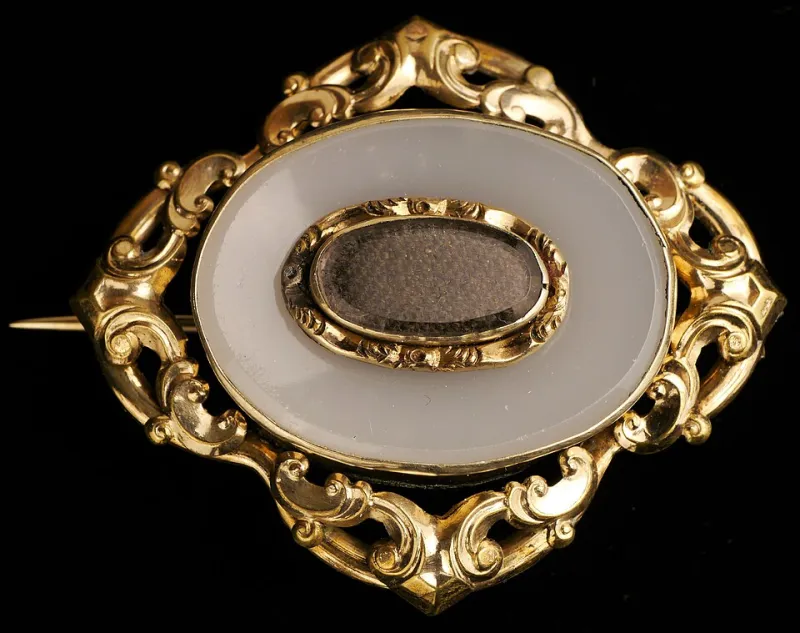
Photo: Thayne Tuason, CC BY-SA 4.0, via Wikimedia Commons
Somewhere in an antiques shop in Camden Passage, there is a brooch containing the hair of a woman who died in 1861. Her initials are woven in gold thread around it. Someone loved her enough to wear her against their collarbone for the rest of their life.
We have decided, collectively, that this is macabre. I think we've got it backwards.
The Etiquette of Absence
Victorian mourning jewellery wasn't a gothic affectation — it was a social institution with rules as rigid as anything in Debrett's. Full mourning demanded jet and vulcanite; half mourning permitted onyx, garnet, and eventually pearl. Pieces were woven from the hair of the deceased, set under rock crystal, or enamelled with forget-me-nots and willows.
Queen Victoria set the tone after Albert's death in 1861, wearing mourning until her own. But the practice filtered through every class. Working families commissioned cheap jet brooches from Whitby, where the jet industry employed hundreds at its peak. Grief, for the Victorians, was something you wore — publicly, correctly, and for a stipulated term.
Compare that to now. We get three days of compassionate leave, a card from HR, and the expectation that we'll be 'back to normal' by spring. Grief has been privatised, hidden, pathologised. The Victorians wore their dead on their lapels; we're told to download an app.
What the Dealers Say
'It's changed enormously in the last decade,' says one London antique dealer specialising in mourning pieces, who asked to remain anonymous because, she laughs, 'my neighbours still think I trade in witchcraft.' 'Twenty years ago, hairwork horrified people. Now it's usually the first thing younger collectors ask for. They want the human connection. A plain onyx brooch is beautiful, but a brooch with a name and a date — that's a person.'
She's noticed another shift: pieces are being bought as gifts for the bereaved. 'Someone bought a mourning ring for her mother after her father died. Not to replace anything — to acknowledge it. To say, your grief is real and it deserves an object.'
A Beginner's Field Guide
If this has stirred something, here's how to start.
Know your materials. Genuine Whitby jet is warm to the touch, lightweight, and leaves a brown streak when rubbed on unglazed porcelain; glass and vulcanite imitations feel cold and look shinier. Vulcanite, a hard rubber used extensively in the 1860s–80s, often fades to brown at the surface with age.
Read the back. Victorian mourning pieces are usually inscribed — names, dates, sometimes age at death. A piece with a full inscription has provenance and pathos; a blank one may be sentimental rather than strictly mourning. Check the pin style too: long, slender C-clasp pins suggest pre-1880s.
Hairwork isn't always visible. Look for woven hair behind glass panels or coiled inside lockets. Under magnification you'll see the individual strands. Reproductions often use painted designs or synthetic fibres that clump.
Where to hunt. Portobello and Bermondsey antiques markets, regional auction houses (many run dedicated jewellery sales online now), and specialist fairs like the one at Alfies Antiques Market in Marylebone. Expect £40–£150 for a good entry-level jet brooch; hairwork rings and pieces with exceptional inscriptions run higher. Buy from dealers who'll let you inspect closely, and be wary of anything described as 'Victorian style' — that phrase exists for a reason.
An Argument, Briefly
The objection is obvious: isn't wearing the dead a bit much? But consider what we do instead. Ashes in a box on a shelf, or scattered somewhere we'll never visit again. A funeral that costs thousands and is over in an hour.
A mourning brooch is a relationship continued. It says: this person existed, they mattered, and I am not finished with my love for them. The Victorians gave grief a wardrobe because they understood that mourning needs somewhere to go. Ours has nowhere to go at all.
I own one piece — a small onyx locket, 1874, a child's name inside. I don't wear it often. But I know it's there, in the dark of the drawer, doing what it was made to do: remembering.