The Last Round: How Our Grandparents Put a House to Bed
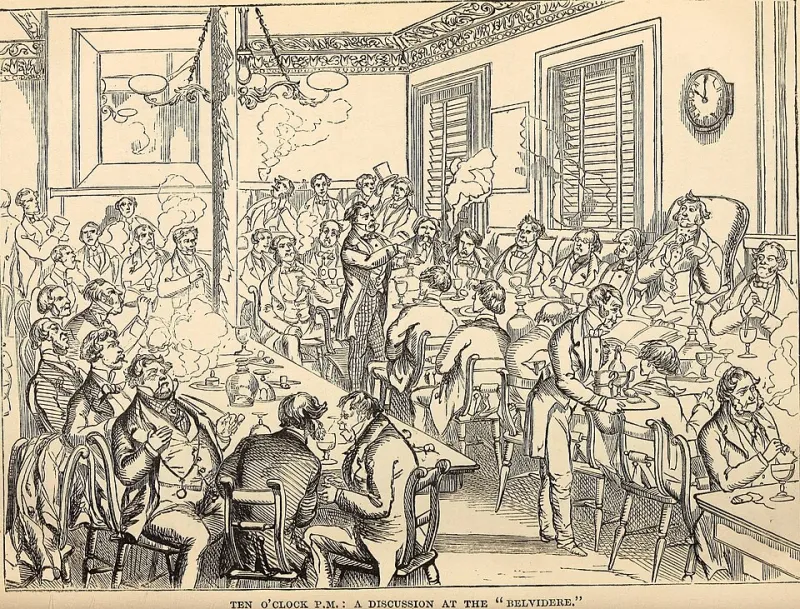
Photo: Sala, George Augustus, 1828-1895; McConnell, William, 1833-1867, No restrictions, via Wikimedia Commons
There's a phrase older relatives used that has all but vanished from the language: putting the house to bed. Not going to bed yourself — putting the house to bed. As if the home were an animal in a stable, something warm-blooded and dependent that needed settling before the household could properly rest.
It was a real sequence of tasks, carried out in roughly the same order every night, in terraced houses in Leeds and crofts on Skye and semis in Surbiton. And I've started doing a version of it myself. I'd like to make the case that you should too.
What the Last Round Actually Involved
The details varied by decade and region, but the bones of it were consistent. The fire was banked — raked together, smothered with slack or a coal-sack over the grate, so it would smoulder rather than die and be easier to wake in the morning. The kettle was filled and set on the hob. The blackout curtains, during and long after the war, were drawn with a fussiness that bordered on ceremony. Doors were checked. Keys turned. Lamps carried from room to room as the last light was extinguished behind you.
Dr Eleanor Voss, a historian of domestic life who has written extensively on British household management manuals, describes it as "a second, gentler shift".
"The evening round was work, technically," she told me. "But it was work with no audience and no deadline. Nobody was watching you bank a fire. It was one of the few tasks in a woman's or a man's day that existed purely for the household's own sake. There's something psychologically precious in that."
She points out that the routine had a built-in logic: it moved through the house. You weren't standing still at a sink. You were walking the perimeter, touching the things that kept you safe — the latch, the curtain, the coals — and confirming, room by room, that all was well.
"It's a homecoming that happens every night, inside your own home," Voss says. "Modern life has almost nothing that repeats in that way."
Why Anxious Minds Missed It When It Went
Central heating killed the banking of fires. Light pollution and roller blinds killed the ritual of the blackout. And the humble latch-key check was outsourced, for most of us, to a glance at a phone app showing a padlock.
But there's a reason so many of us lie awake at 2am running an audit of the house in our heads. Did I lock the back door? Is the iron off? Is the car locked? The modern mind does the last round in bed, badly, because nobody did it properly on the way up.
Psychologists call this theZeigarnik effect — the mind's tendency to hold onto unfinished tasks. Our grandparents' routine was, without knowing the term, a nightly way of closing open loops. The house itself confirmed it was done. The doors answered back under your hand.
There's also the matter of light. Drawing heavy curtains and dimming lamps room by room is, functionally, a melatonin ritual. You're not just securing the house; you're telling your own body that the day has ended. We've replaced that with screens that do the exact opposite.
Building Your Own Last Round
You don't need a grate or a scuttle. The principle transfers to any home, rented flat included. The rules are simple: it must be physical, it must move through the house, and it must be done in the same order most nights.
1. Begin at the kitchen. Fill the kettle for the morning, rinse the mug, and — this is the crucial bit — put the kettle back on its base. A small kindness to tomorrow's you.
2. Bank what needs banking. If you have a wood burner, rake and damp down the embers. If not, bank the house: switch off and unplug the obvious offenders, turn the heating down a notch, close the washing machine drawer. Small, deliberate acts of closure.
3. Walk the perimeter. Back door, back window, front door. Hands on the locks — actually touch them. This is the part that pays for itself at 2am.
4. Draw the curtains like you mean it. Heavy ones, if you've got them. Blackout linings are the modern equivalent of wartime practice, and they work.
5. Kill the lights behind you. Move room to room, lamp to lamp, ending in the one where you'll sleep. The house darkens in your wake. You are, quite literally, putting it to bed.
6. Say something, if it helps. Voss mentions that some of her older interviewees had a phrase — "all's well" or "that's the lot" — murmured at the final door. A spoken ending gives the round a full stop. It sounds eccentric. It works.
The Point of It All
The last round takes ten minutes. It asks nothing of you but attention, and it gives back a house that has been answered — every lock confirmed, every flame settled, every window blind to the street.
What our grandparents understood is that a home isn't just a place you live; it's a thing you tend. And that tending, done at night, in the right order, with your own two hands, is one of the oldest and cheapest forms of calm available to us.
The dark outside is the same dark it always was. The trick is meeting it with a house that's ready.