Where the Stones Remember: Seven British Burial Grounds Worth a Sunday Walk
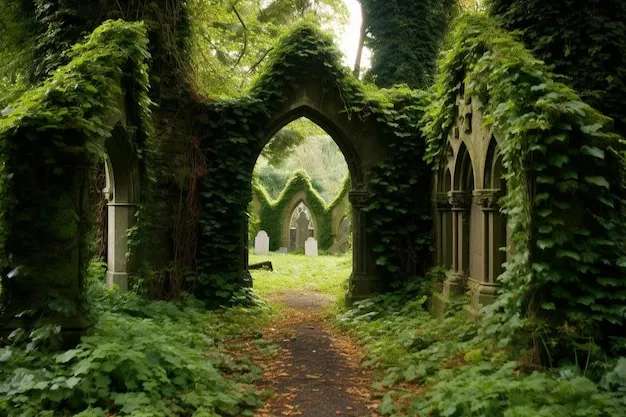
Photo: overgrown Victorian cemetery sunlit gothic gravestones ivy, via img.freepik.com
There's a peculiar English habit of apologising for liking graveyards. You'll hear it at the gate: 'I'm not morbid or anything, I just like the history.' As though the only acceptable reason to enjoy a sunlit Victorian cemetery is an academic excuse.
We'd like to drop the apology. The great burial grounds of Britain are, quite simply, some of the finest contemplative spaces we have. They're quiet without being empty, wild without being uncared for, and full of the kind of architecture and social history that most museums would charge a tenner for. And unlike a National Trust property on a bank holiday, you can hear birdsong.
Here are seven worth your Sunday.
Highgate Cemetery, London
Start with the obvious, but go properly. Yes, Karl Marx is here under an enormous bronze head, and yes, the Victorian Gothic colonnades of the Egyptian Avenue are everything people promise. But come on a weekday morning in autumn and you'll understand the real draw: the way the ivy has taken the monuments as scaffolding, the light coming down through the old beeches. Book the West Cemetery tour for the atmospheric bits.
Nunhead Cemetery, London
The least visited of the Magnificent Seven, and therefore the best for walking. Nunhead went properly feral in the decades after it closed — sycamores self-seeded between the headstones, the Anglican chapel ruin sits in green shadow — and that neglect became a kind of gift. The view from the summit over the city is one of London's least known panoramas.
St Michael's Churchyard, Haworth, West Yorkshire
The Brontë parsonage churchyard gets busy at the front, but walk to the far wall and it empties out. The moor is right there beyond the stone, the wind does most of the talking, and the mass of dark headstones — packed shoulder to shoulder like a crowd — is genuinely moving. Bring a flask. Sit on the bench. Let the Brontë weather do its work.
Arnos Vale Cemetery, Bristol
A 183-acre Victorian garden cemetery wedged into a valley between Bristol's streets, Arnos Vale was nearly lost to developers in the 1980s before locals fought it back. Now it's beautifully managed: paths wind past a Greek revival chapel, through woodland, alongside graves of soldiers, sailors, and the ordinary Bristolians whose names nobody remembers. There's a café in the reception building, which feels almost subversive given how contemplative the place is.
Stoney Royd Cemetery, Halifax
A Pennine gem that deserves far more visitors than it gets. Opened in 1861 on a steep hillside, Stoney Royd has all the Victorian confidence of the era — chapels, curving drives, sandstone monuments — softened by 160 years of moss, lichen and weather rolling in off the moors. On a clear day the views across Calderdale are extraordinary.
Cathcart Cemetery, Glasgow
South of the city, on the banks of the White Cart Water, Cathcart is where Glaswegians go to walk without announcing it. Mature trees, Victorian stone worn soft, and a riverside path that carries on well beyond the gates. It's peaceful in the specific way that only Scottish graveyards are — the rain keeps the crowds away and the moss luminous.
St Enodoc Church, Cornwall
Not a cemetery with a church attached, but a church that has spent centuries being buried by sand. St Enodoc sits in the dunes above the Camel Estuary, reachable on foot across the golf course, its little tower half-sunk like a sandcastle the tide forgot. John Betjeman is buried here. The whole setting feels less like a burial ground and more like a place the land itself has decided to keep.
How to Walk a Graveyard
A few unspoken rules, for the benefit of everyone.
Go in the morning. The light is better and the spaces are emptier. Read the stones — the short lives, the lost siblings listed in rows, the trades and the ships — and let some of it land. Take nothing but photographs and leave the wildflowers alone; the nettles and brambles are doing conservation work. And if you find a bench, use it. These places were designed as landscapes first and burial grounds second. The Victorians built them for exactly what you're doing: a walk, a sit, a think.
There's nothing morbid about any of it. A cemetery is a record of a whole community, laid out in stone, kept quiet and green. You could do a lot worse with your Sunday afternoon.