The Grey Cathedral: A Field Guide to Bathing in Britain's Fog
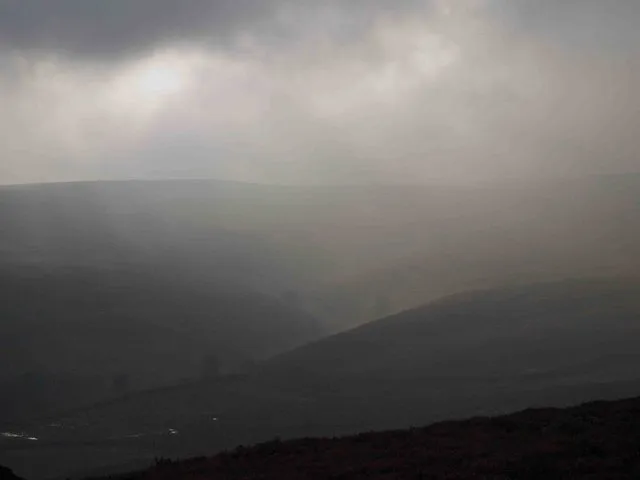
Photo: Steve F, CC BY-SA 2.0, via Wikimedia Commons
Wellness culture has a lighting problem. Everything is bright, white, ring-lit and optimised. Retreats are advertised with photographs of sunlit decks. Apps ping at you to breathe in rooms with the blinds up. Even the language of calm has been bleached — clear your mind, brighten your mood, lighten your load. Somewhere along the way, we decided that feeling better meant seeing more clearly.
Fog disagrees. Fog is the rare weather that asks you to see less, and to be alright with that.
What fog bathing actually is
Strip away the name and it is embarrassingly simple: you go outside when visibility drops, and you walk slowly, and you do not try to get anywhere. You let the world shrink to the size of a room. Ten metres of hedgerow becomes the whole of the visible universe. The rest is held in trust by the grey.
It has become a small trend of late, in the way that most quiet things eventually do once someone gives them a hashtag. But it is not new. Anyone who has ever stood on a platform at six in the morning in November, waiting for a train that may or may not exist, has already done it by accident. The only innovation is doing it on purpose, and noticing.
Why Britain is unusually well suited to this
We are, as a nation, professionally misty. Our island sits in the path of mild, wet air coming off the Atlantic, and when that air cools over cold ground — or cold sea — it condenses into the low, soft stuff that has been ruining painters' attempts at a horizon for centuries. Eastern England gets radiation fog on clear, still autumn nights, the kind that settles in the Fens and along the Broads and sits there like a held breath until the sun burns it off. Upland Britain gets the other sort: cloud that has simply come down to walk among the sheep.
This is not a consolation prize. It is the point. A country with reliable fog has a standing invitation to practise uncertainty indoors and out, and it costs nothing at all.
The kit, which is almost nothing
Warm layers, because fog is wet cold and it finds the gaps. A torch, though you will use it less than you think — a beam in fog bounces back at you and can actually make things harder to see. Reflective or light-coloured outer layer if you are anywhere near a road, and that is not a small point; drivers in fog are worse at this than you are. A phone with a map you have already downloaded, because signal in mist is not a given.
And a working sense of direction. This is the one genuine piece of caution: fog removes landmarks, and landmark-free walking is how people end up somewhere they did not plan to be. Know your route, keep a mental tether to a path, a wall, a stream, a line of pylons. Do not go up onto open moorland in poor visibility unless you genuinely know the ground. Dartmoor in fog is beautiful and entirely indifferent to you.
Three places to lose yourself, safely
The Norfolk Broads. Low country, low water, low sky. Fog here has nowhere to go and so it simply sits, folding the reed beds into the river until you cannot tell where one ends. Walk a towpath early, before the hire boats start. The herons sound enormous and invisible simultaneously.
Dartmoor, in the valleys rather than the tops. Stay low. Follow a known lane or leat where you can keep your hand near something solid. The tors will appear and disappear like the punchline to a joke you never hear. There is a reason this place has a reputation for swallowing people; respect it, and it becomes one of the most quietly moving landscapes in England.
The Scottish lochs, particularly in the west. Mist coming off still water at first light is close to the finest thing these islands produce. Do not wander; sit. A jetty, a slipway, a bench. The water holds the grey and gives it back slowly.
A short ritual for sitting with uncertainty
Find somewhere you can stop — a gate, a bench, a drystone wall. Stand still until your breathing slows on its own.
- Let your eyes soften rather than strain. You are not trying to see through the fog; you are letting it do what it does.
- Name three sounds. That is all. The fog will sharpen them for you.
- Say, silently or otherwise, one thing you have been trying to force clarity on. A decision, a worry, a person. Do not attempt to solve it.
- Hold it there for a minute, unhurried, the way you would hold a wet coat at arm's length.
- Then turn and walk back the way you came.
The point is not to reach an answer. The point is to practise being inside a situation you cannot see the edges of, and to notice that you are still standing. Most of us get very little rehearsal for that, and then life hands us a week in February where nothing is legible and we panic.
Coming back
When the fog lifts, it goes quickly. Walls reappear. A church tower you had forgotten was there reassembles itself. The temptation is to feel relieved and get on with the day.
Resist it for a moment. Stand still for the ten seconds it takes for the world to come back and register that you liked it better when you could not see the horizon. That is not a failing. That is the whole practice, and it is available to anyone with a free morning, two jumpers, and a willingness to be a little bit lost on purpose.