In Praise of the Blackened Jar: A Case for Eating Like the Lights Are Off
There's a particular kind of exhaustion that comes from eating 'well' in the modern sense. The pale green smoothie. The avocado, flown in from somewhere perpetually summer. The salad that looks like a meadow and tastes like a chore. We've built an entire idea of healthy eating around brightness — freshness, light, the illusion that every meal happens in July.
But nobody in this country has ever actually lived like that. Not the farmers, not the monks, not your nan. Britain's real food tradition is darker, older and considerably more interesting. It lives in the cupboard, not the fridge.
What the Larder Knew
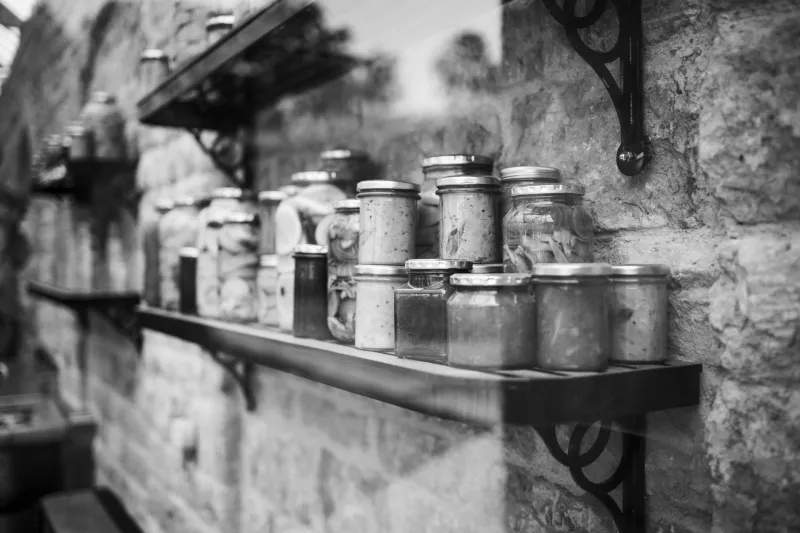
Before the supermarket promised us eternal summer, the year had a shape. Summer was for growing; the rest of it was for surviving on what you'd captured. Hence the pantry: shelves of pickled onions, jars of damson gin, bundles of dried mushrooms from the autumn forage, a crock of sauerkraut quietly doing its thing in the corner.
This wasn't deprivation. It was transformation. A pickled walnut is a fresh walnut that has been through something. Black garlic — whole bulbs aged until the cloves turn jet-black, soft and balsamic-sweet — is garlic that has surrendered entirely and become something else. Molasses, treacle, dark dried fruit: these are foods that lean into the dark rather than apologising for it.
There's a lesson in there, and it isn't really about food.
The Tyranny of Fresh
Modern wellness eating has a strange anxiety at its centre: the fear of time. Everything must be fresh, raw, immediate. Food left alone is suspect — fermented, aged and cured things get grudging approval only once they've been rebranded as 'gut health'.
But sit with a larder for a while and you notice the opposite truth. Time, given room, improves things. A jar of onion pickle made in October is a different creature in February — sharper, rounder, more itself. The dried porcini that seemed dead in September becomes the deepest thing in your kitchen by midwinter, bloomed in hot water, its liquor more valuable than the mushroom.
Nothing about this is rushed. Nothing about it is optimised. It is, in other words, everything modern eating is not.
How to Eat Like It's January (Even If It Is)
The dark pantry diet isn't a diet in the miserable sense. Nobody's weighing anything. It's more a posture — a way of shopping and cooking that accepts the season you're actually in. A few principles:
Shop the shadows of the supermarket. The vinegar aisle, the tinned goods, the world foods section with its black beans, molasses and preserved lemons. The fresh produce aisle gets all the light; the dark shelves get all the flavour.
Put something up. One jar. That's all. Pickled red cabbage takes twenty minutes and gets better every week you ignore it. The act of sealing something away and letting it be is half the ritual.
Bloom your dried things. Mushrooms, chillies, sun-dried tomatoes. Rehydrate them properly, keep the liquid, and you've conjoured depth out of nothing.
Cook darker. Braises, stews, blackened onions, toast scraped with marmite and molasses. Colour in food comes from time and heat — both things January has in abundance.
A Quieter Kind of Nourishment
I've started thinking of the larder as a kind of mindfulness practice that happens to produce dinner. You can't hurry a pickled walnut. You can't rush black garlic. These are foods that demand you accept that some things take as long as they take — a sentiment that would do most of us good well beyond the kitchen.
There's also something quietly comforting about a cupboard that's full. The Victorians knew it; the wartime generation knew it. A shelf of jars is a small hedge against the dark — proof that a version of you, months ago, did something kind for the person you'd become.
So this year, skip the bright resolutions. Buy a cabbage, a bottle of malt vinegar and a jar with a good clip-top lid. Put something away. Let it sit in the dark and get better.
We could all stand to be a little more like a pickled onion: preserved, complicated, improved by the shadows.